 ultimate-guide
How to Choose a Chef Knife: A Practical Buying Guide
Last Updated: November 2, 2026
Quick Summary
To learn how to choose a chef knife, start with blade length, which is usually 8 inches for most home kitchens or 6 inches for smaller counters and smaller hands. Then check the steel type and hardness, balance at the bolster, and whether the handle fits your grip. Match the steel to how much sharpening you are willing to do.
- An 8-inch blade covers the widest range of jobs for many home kitchens.
- Choose a 6-inch blade for a compact counter, cooking for one or two, or if longer blades are hard to manage.
- Chef knives generally fall within roughly 55 to 65 HRC, and harder blades are more brittle.
- Test the handle by gripping the knife as you would while chopping; cramping or slipping means the wrong fit.
- Judge a knife by total cost of ownership, including how often it needs sharpening, not just the purchase price.
Table of Contents
- What a Chef Knife Does and Who Needs One
- Choosing Blade Length: 6-Inch vs. 8-Inch Chef Knife
- Blade Shape, Profile and Geometry
- Steel Type, Hardness and Edge Retention Trade-Offs
- Weight, Balance, Handle Material and Grip Fit
- Western vs. Japanese Chef Knives: Which Suits Your Cooking
- The Best Japanese Chef Knife Options to Consider
- Evaluating Chef Knife Brands and Total Cost of Ownership
- In-Store and Online Buying Checklist, Plus Safe Handling Tips
- Booking Your Next Step: Pick Your First Chef Knife Today
- Frequently Asked Questions
What a Chef Knife Does and Who Needs One
A chef knife is the workhorse of the kitchen: a single blade built for chopping, slicing, dicing and mincing most vegetables, herbs, meat and fish. A common pattern is that shoppers buy a cheap block set, then discover that the blades won't hold an edge and the handles feel wrong after ten minutes of prep.
Our advice is to learn how to choose a chef knife before buying anything else, starting with one good blade. Most home cooks reach for it more than any other tool, so it deserves the largest share of your budget. Young adults setting up a first apartment, homeowners outfitting a renovated kitchen and dedicated home cooks all benefit from the same starting point.
A simple test helps: if you cook most evenings and find yourself struggling to get clean cuts, a proper chef knife will change your prep time more than any gadget. If you rarely cook, a basic model is enough. Consumer Reports' tested eight-inch chef's knives from Henckels, Mac and Wüsthof is a useful place to see how common brands perform in real kitchen testing.
Choosing Blade Length: 6-Inch vs. 8-Inch Chef Knife
The two sizes that matter most are 6 inches and 8 inches. An 8-inch blade gives you more length per stroke, which suits large vegetables, squash and bulk prep. A 6-inch blade is easier to control for smaller tasks and for cooks with smaller hands.
An 8-inch knife covers the widest range of jobs for many home kitchens. Choose a 6-inch model if you have a compact counter, mostly cook for one or two people, or find longer blades hard to manage.
If you are weighing the two, try holding each in a store if possible. Pay attention to whether the tip sits comfortably over your board when your knuckles clear the cutting surface.
Blade Shape, Profile and Geometry
Blade shape affects how the knife moves through food. A curved edge supports the rocking motion many Western-style cooks use, while a flatter profile suits push cuts and precise slicing. The belly, the curved section near the tip, determines how easily you can rock the blade.
Geometry also matters. A thin bevel slices cleanly but can chip under heavy use, while a thicker, wider bevel is more durable and better for dense foods. Look for a blade that tapers toward the edge without feeling fragile at the spine.
Watch out: a very thin blade can look impressive on the shelf but may flex or chip when you cut through squash or frozen food.
Steel Type, Hardness and Edge Retention Trade-Offs
Steel choice is often misjudged, because buyers tend to shop for one property, usually "sharpest," when every steel is a bundle of properties that pull against each other. Understanding how those four interact is more useful than memorizing alloy names.
The four properties and what they mean in use:
- Hardness is measured on the Rockwell C scale (HRC). Chef knives generally fall within a range of roughly 55 to 65 HRC. A harder blade resists rolling and holds a fine edge longer, but it is more brittle and takes more effort to sharpen.
- Toughness is the ability to absorb impact without chipping. Toughness falls as hardness rises. A 60 HRC blade that meets a frozen chicken or a squash stem can chip where a 56 HRC blade would simply roll.
- Corrosion resistance depends on chromium content. Stainless steels generally contain at least 12-13% chromium, which forms a passive oxide layer. Carbon steels have little chromium, so they patina and can rust if left wet.
- Edge retention is the practical result of hardness plus wear resistance plus how you use and maintain the edge. It is not a single number on a spec sheet.
The core trade-off: no steel excels at all four. A very hard, high-wear steel (common in Japanese gyuto) gives long edge life and clean slices but demands careful technique and water stones.
Common steel families you will see:
- 440C stainless, a widely used, corrosion-resistant steel that takes a good edge and is reasonably tough. A practical middle ground for home cooks.
- VG-10 and similar vanadium steels, hard, wear-resistant stainless steels that hold an edge well; they reward careful sharpening and punish careless chopping.
- 9CR18MOV / 9CrMoV, a layered or single-layer stainless often used at lower price points; decent corrosion resistance and edge life, but generally not as hard as premium steels.
- Carbon steels (e.g., white and blue paper steels), can take a very keen edge and are easy to sharpen, but require drying after every wash and will stain.
How to read a spec sheet: treat the stated HRC as a starting point, not a verdict. A 58 HRC VG-10 blade and a 58 HRC 440C blade behave differently because wear resistance and toughness differ.
For most households, a stainless blade in the mid-50s to around 58 HRC offers the best balance of edge life, durability, and low maintenance.
The table below summarises the main steel families and the trade-offs each one carries.
| Steel | Key strength | Key trade-off |
|---|---|---|
| 440C stainless | Corrosion-resistant, reasonably tough | Practical middle ground for home cooks |
| VG-10 and similar vanadium steels | Hard, wear-resistant, holds an edge well | Rewards careful sharpening, punishes careless chopping |
| 9CR18MOV / 9CrMoV | Decent corrosion resistance and edge life | Generally not as hard as premium steels |
| Carbon steels | Takes a very keen edge, easy to sharpen | Must be dried after washing, will stain |
| Hardness (HRC) | Chef knives generally roughly 55 to 65 HRC | Harder resists rolling but is more brittle |
Weight, Balance, Handle Material and Grip Fit
Balance is where the blade and handle meet. A well-balanced knife feels stable at the bolster, the thick junction between blade and handle, rather than pulling forward or backward.
Handle material affects comfort and hygiene. Wood feels warm but needs care. Synthetic handles are easier to clean and usually cheaper. Pay attention to shape as well: a handle that fits your pinch grip, where thumb and forefinger pinch the blade near the bolster, gives the most control.
Test the fit by gripping the knife as you would while chopping. If your hand cramps or slides, the knife is the wrong size for you.
Western vs. Japanese Chef Knives: Which Suits Your Cooking
Western-style chef knives tend to be heavier, thicker and more strong, with a curved edge suited to rocking cuts. Japanese-style knives, such as gyuto models, are usually lighter and thinner with harder steel, offering sharper cutting and more precise slices.
Choose Western if you want a forgiving, all-purpose knife for heavy use and rough handling. Choose Japanese if you cook precise, delicate prep and are willing to hand-wash and sharpen with care.
Many home cooks find a Western 8-inch knife covers most needs, and a Japanese knife becomes a worthwhile second purchase later.
The Best Japanese Chef Knife Options to Consider
If you are leaning toward a Japanese-style blade, these options from our catalog show how the features vary:
-
Keihatsu Japanese Gyuto Chef Knife, 8-inch Kiritsuke [page:1] uses 440C stainless steel with a professional kitchen design.
- Pros: Hard, sharp steel suited to precise cuts.
- Cons: Requires careful sharpening to keep its edge.
- Best for: Cooks who want a thin, precise gyuto.
- Skip if: You want a heavy, forgiving knife for rough prep.
-
Japanese Vanadium Steel Chef Knife, 7.8-inch [page:2] uses molybdenum vanadium steel with a laser-patterned blade.
- Pros: Strong edge retention and a 7.8-inch length for control.
- Cons: Less common steel to sharpen at home.
- Best for: Cooks who want a slightly shorter, hard-wearing blade.
- Skip if: You prefer a traditional stainless finish that is simple to care for.
-
8-inch Professional Japanese Gyuto Knife [page:3] has a full-tang design with a natural wood handle.
- Pros: Balanced feel and a classic look.
- Cons: Wood handles need more care than synthetic ones.
- Best for: Cooks who value a traditional gyuto feel.
- Skip if: You want a dishwasher-tolerant handle.
-
8-inch Gyuto Knife with 3-layer 9CR18MOV steel [page:4] pairs a layered blade with a budget-friendly price point.
- Pros: Accessible entry point into Japanese-style knives.
- Cons: Not as hard as premium single-layer steels.
- Best for: Budget-conscious buyers trying a gyuto.
- Skip if: You need the sharpest possible long-term edge.
Pricing depends on current stock and promotions, so check the product pages for today's cost.
Evaluating Chef Knife Brands and Total Cost of Ownership
Brand reputation is a shortcut, not a decision. The more useful frame is total cost of ownership: what you pay up front plus what you spend to keep the knife sharp and usable over its life. A knife you cannot or will not maintain is expensive at any price.
The three cost buckets:
- Purchase price, the sticker cost. This is the only number most shoppers compare, and it is the least predictive of long-term value.
- Sharpening and maintenance, professional sharpening typically runs a per-knife fee each time, and how often you need it depends on steel hardness, cutting surface, and use. A soft steel used daily on a glass board may need attention far more often than a harder steel on end-grain wood. Home sharpening with a whetstone or a guided system has a one-time cost for the stone or kit plus your time.
- Replacement and accessories, a honing rod, a storage solution (sheath, magnetic strip, or block), and eventually replacement if the knife chips, the handle fails, or the edge is sharpened away.
A realistic way to compare two knives: estimate how many times per year each will need sharpening, multiply by your local sharpening cost (or your time if you sharpen at home), add the purchase price, and add any accessories the knife requires. The cheaper knife often loses this comparison once sharpening frequency is included, but not always. A soft stainless knife you sharpen yourself in two minutes is genuinely cheaper to own than a hard blade you pay to have serviced.
Brand evaluation checklist, what to verify before buying:
- Is the steel type and hardness (HRC) stated clearly?
- Is the handle material and construction described (full tang, partial tang, scales, rivets)?
- Are sharpening and care instructions included, and do they match the steel?
- Is there a clear return policy and warranty, and what does it actually cover?
- Does the seller state the blade length and weight, so you can compare like for like?
Match the knife to your maintenance reality: if you will not sharpen, buy a softer stainless blade and a rod, and plan on professional service occasionally. If you enjoy maintenance, a harder steel rewards you with longer edge life. If you want low fuss, prioritize corrosion resistance and a handle that tolerates washing.
Watch out: a "lifetime warranty" that excludes normal wear, chipping from misuse, or sharpening damage is narrower than it sounds, read the exclusions before you rely on it.
Compare current listings from other retailers on the same criteria, and price the maintenance, not just the knife.
In-Store and Online Buying Checklist, Plus Safe Handling Tips
Before you buy, handle the knife if you can. Check balance, weight and grip. If you shop online, read the steel, length, handle and care details carefully, and review the seller's return policy before you buy. Pick up a roller knife sharpening kit to keep your new blade's edge.
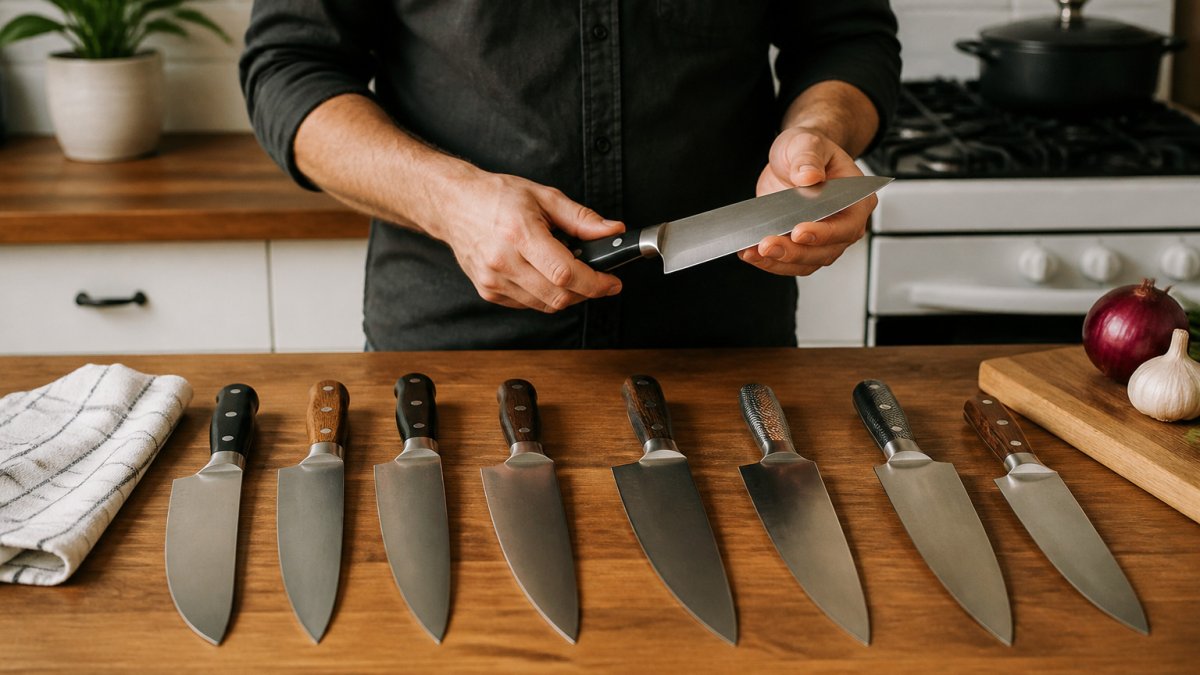
A home cook in a bright apartment kitchen holding an 8-inch chef knife by the handle over a wooden cutting board with fresh vegetables.

Safe handling matters as much as the purchase. Always cut on a stable board, keep the blade edge pointed away from your body, and store the knife in a sheath or magnetic strip.
Booking Your Next Step: Pick Your First Chef Knife Today
Learning how to choose a chef knife comes down to blade length, steel, balance and grip fit. Start with an 8-inch Western knife unless you have a specific reason to go smaller or Japanese. Browse our range and pick the knife that fits how you cook.
Frequently Asked Questions
How do I pick the right chef knife?
Start with the cutting tasks you do most. An 8-inch blade suits most home cooks because it handles chopping, slicing and dicing of larger produce and proteins. Then check the handle for a comfortable pinch or handle grip, confirm the knife feels balanced when you hold it, and choose a steel type that matches how much maintenance you will do. Buying from a store where you can hold the knife, or ordering with a clear return policy, lets you test fit before committing.
Should I get a 6-inch or 8-inch chef knife?
An 8-inch chef knife is the more common choice because it gives more cutting edge for slicing bread-sized loaves, large onions, and whole squash. A 6-inch knife is lighter and easier to control for smaller tasks, precise work, and people with smaller hands. Many cooks own one of each. If you can own only one, pick 8 inches unless you mainly cook for one or two people or have limited counter or drawer space.
What should you look for when buying a chef knife?
Look at blade length, steel type, weight and balance, handle material, and edge retention. Steel hardness is often stated on the Rockwell scale, and chef knives generally fall within roughly 55 to 65 HRC. Harder steel holds an edge longer but can chip, while softer steel is easier to sharpen. Check that the handle is comfortable across several grip styles and that the knife feels neither too heavy nor too light for your wrist.
What is the difference between Japanese and Western chef knives?
Western-style chef knives usually have a thicker blade, a heavier spine and a bolster at the handle junction, and they suit rocking cuts on a board. Japanese-style knives tend to be thinner, lighter and harder, with a single-bevel or double-bevel edge that excels at precise slicing. Japanese knives can chip more easily and often require more careful sharpening and handling. Choose based on your cutting style and how much care you are willing to give the blade.
How do I choose a chef knife for the first time?
For a first chef knife, focus on an 8-inch blade with a comfortable handle, a stainless or high-carbon stainless steel that resists rust, and a weight that feels balanced in your hand. Avoid buying a full knife block set before you know which knives you use. Budget options can perform well for everyday tasks, and you can upgrade later once you know what you need. Keep a honing rod or sharpening plan so the knife stays usable.
What knife features matter most for everyday home cooking?
For everyday cooking, the most useful features are a comfortable grip, reliable edge retention, easy sharpening, and a blade length that fits your cutting board and typical ingredients. Full tang construction, where the steel runs through the handle, generally adds durability and balance. Dishwasher safety is less important than hand washing and drying, since most good chef knives last longer when cleaned by hand and stored on a magnetic strip or in a block.
Is an expensive chef knife worth it?
A higher price often buys better steel, more precise grinding and a more refined handle, but it does not guarantee a better fit for you. Compare total cost of ownership, including sharpening, honing tools and replacement risk. Pricing varies by brand, material and retailer, so check current prices and return terms directly on the Home Pro Kitchen Supply website before you buy.