 how-to
How Do You Season a Cast Iron Skillet at Home?
Last Updated: November 1, 2026
Quick Summary
To season cast iron skillet cookware at home, clean and dry the pan, apply a very thin coat of high smoke point oil, then wipe off the excess. Bake it upside down at 450 to 500 degrees Fahrenheit for one hour, let it cool, and repeat two or three times.
- Wipe the oil back off until the pan looks almost dry; too much oil causes sticky seasoning.
- Preheat the oven to 450 to 500 degrees Fahrenheit and bake the skillet upside down for one hour.
- Repeat the oiling and baking process two or three times to build a durable base layer.
- Choose a high smoke point oil such as canola, vegetable, grapeseed, or sunflower oil; olive oil is not recommended for the initial bake.
- Touch up worn spots on the stovetop and let everyday cooking maintain the surface.
Table of Contents
- What Seasoning Does for a Cast Iron Skillet and What You'll Need
- Step 1: Clean and Dry the Skillet Before Seasoning
- Best Oil for Seasoning Cast Iron and How to Apply It
- How to Season Cast Iron in the Oven
- Troubleshooting Sticky or Patchy Seasoning and How Often to Season Again
- Frequently Asked Questions
What Seasoning Does for a Cast Iron Skillet and What You'll Need
Seasoning is the thin, baked-on layer of oil that turns raw cast iron into a surface food can release from, and learning to season cast iron skillet surfaces properly is the foundation of good results. Home Pro Kitchen Supply offers cookware, and this step-by-step guide shows you how to season a skillet at home with basic supplies. Seasoning is simply oil heated until it polymerizes, bonding to the metal and forming a protective coating. That coating helps prevent rust and gives the pan its naturally nonstick surface over time.
Here is what you'll need:
- A cast iron skillet, new or used
- Warm water and mild soap (or plain hot water for a light clean)
- A stiff brush or scrub pad
- Paper towels or a clean lint-free cloth
- A high smoke point cooking oil
- A baking sheet or foil to catch drips
- An oven with a rack you can position in the center
Generally, building seasoning in several thin layers rather than one thick coat is the common recommendation for even curing.
Step 1: Clean and Dry the Skillet Before Seasoning
Start by removing any factory residue or rust. New pans often carry a coating that keeps them from rusting during shipping. Scrub the pan with warm, soapy water and rinse it well.
- Scrub off rust with a stiff brush or fine steel wool
- Rinse thoroughly and dry right away
- Set the pan on a warm burner or in a low oven to dry completely
Moisture is the enemy here. A damp pan can flash-rust before you ever apply oil, so dry it thoroughly with paper towels.
Best Oil for Seasoning Cast Iron and How to Apply It
There is no single miracle oil. What matters far more than brand or seed is that you apply a coat thin enough to cure hard instead of gummy. That said, oil choice does shape how fast the layer builds, how dark it gets, and how much smoke you deal with. Here is how the common options actually compare.
| Oil | Smoke point (approx.) | Practical trade-off |
|---|---|---|
| Flaxseed | ~225°F | Cures to a hard, glossy layer fast, but is expensive, goes rancid quickly, and some cooks report flaking after repeated coats. Treat it as optional, not required. |
| Canola | ~400°F | Cheap, everywhere, neutral. A reliable everyday choice that builds slowly but evenly. |
| Vegetable (soybean blend) | ~400-450°F | Same role as canola; widely available and forgiving. |
| Grapeseed | ~420°F | Popular with cast iron makers for a hard, even finish; pricier and less common in small kitchens. |
| Sunflower | ~440°F | Good high-heat option; availability varies by region. |
| Shortening or lard | ~370-400°F | Traditional, cheap, and produces a matte finish; animal fats can smell during the bake. |
A few practical rules cut through the noise:
- Thin beats perfect. A microscopic coat of canola outperforms a heavy coat of flaxseed every time.
- Match the oil to your smoke tolerance. If your kitchen vents poorly, a 400°F-plus oil baked at 450°F will smoke. Crack a window and run the vent hood.
- Skip olive oil for the initial bake. Its smoke point (~350-410°F depending on grade) sits below typical seasoning temperatures, so it smokes and can leave a tacky layer. It is fine for everyday cooking, not for building the base.
- Don't mix oils mid-build if you can avoid it. Different fats cure at different rates; pick one and finish two or three coats with it.
Applying the oil
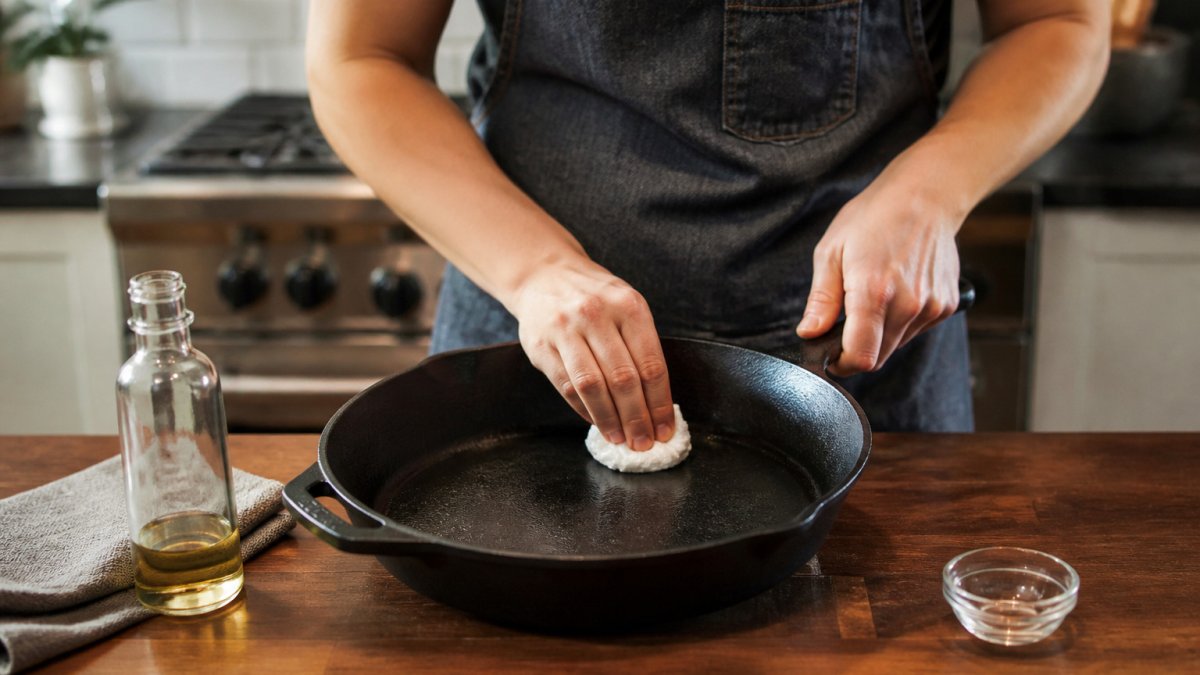
- Pour about a teaspoon onto the skillet, a little goes a long way.
- Rub it over every surface, inside and out, including the handle and the underside, with a paper towel.
- Wipe it all back off with a clean paper towel until the pan looks almost dry. This is the step beginners skip, and it is the single biggest cause of sticky seasoning.
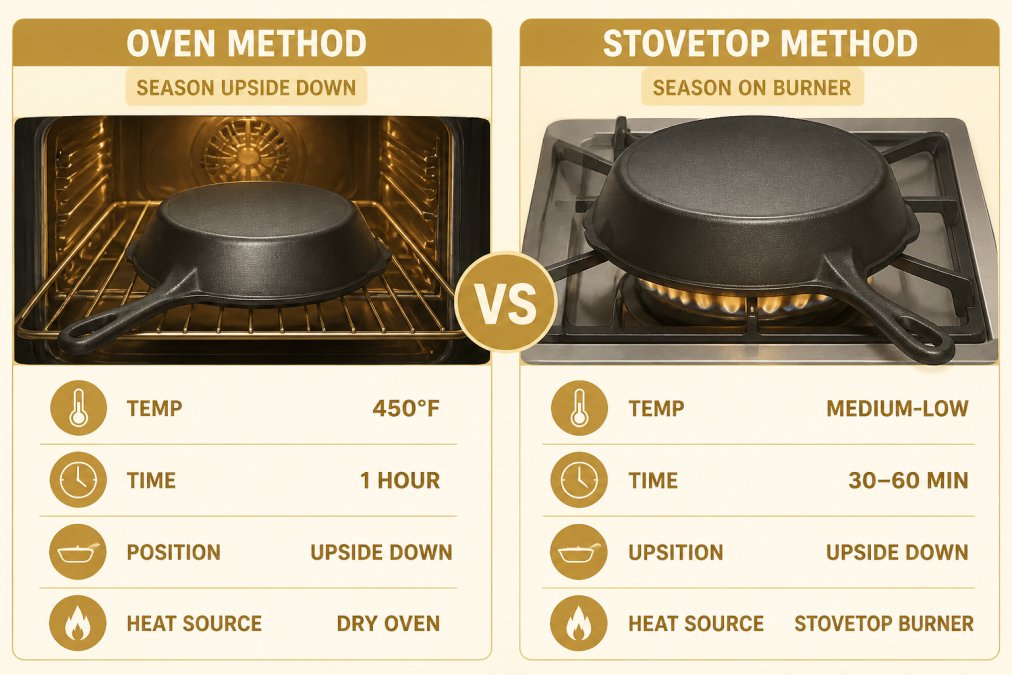
Oven versus stovetop seasoning
Oven seasoning gives you even coverage across the whole pan, including the exterior, and is the right call when you season cast iron skillet cookware that is new or needs a full re-season. It takes about an hour of bake time plus cool-down.
Stovetop seasoning works on the cooking surface only.
How to Season Cast Iron in the Oven
Preheat your oven to 450 to 500 degrees Fahrenheit. Place the skillet upside down on the middle rack, with a baking sheet or foil on the rack below to catch drips. Bake for one hour, then turn the oven off and let the pan cool completely inside.
Repeat the oiling and baking process two or three times for a durable base layer. Each round adds a thin, smooth coat.
Troubleshooting Sticky or Patchy Seasoning and How Often to Season Again
Most seasoning problems come down to one of three causes: too much oil, too little heat, or too little wiping. Here is how to read the symptom and fix it without stripping the whole pan.
Diagnose by symptom
- Tacky or sticky surface. The oil did not fully polymerize. Usually too thick a coat or an oven that ran cool. Fix: heat the pan to 450-500°F, wipe the surface with a thin film of oil, and bake another hour. Repeat once if needed.
- Patchy, blotchy, or streaky finish. Uneven oil application. Fix: keep cooking on it. Patchiness evens out with use and is cosmetic, not damage.
- Flaking or peeling. Layers built up too thick, or a low-smoke-point oil was used at high heat. Fix: scrub the loose flakes off with a stiff brush and hot water, dry thoroughly, and apply two thin coats.
- Dull gray or rust spots. The seasoning wore through or moisture sat on the pan. Fix: scrub the rust off with steel wool, wash, dry on a burner, and re-season the affected area or the whole pan.
- Food sticking in one zone. A thin or worn spot, often the center where heat is highest. Fix: stovetop touch-up on that zone, then cook fatty foods like bacon or cornbread a few times to rebuild.
When to re-season versus when to just cook
A full re-season is warranted when rust is widespread, seasoning is flaking across the cooking surface, or the pan was accidentally left wet or run through a dishwasher. Otherwise, the fix is usually a stovetop touch-up plus a few sessions of cooking with a little extra fat.
Routine full stripping is unnecessary for most home cooks. A common pattern is to season once when the pan is new or acquired used, touch up as needed, and let everyday cooking maintain the surface. If you cook with cast iron several times a week, you may never need a full oven re-season again.
Signs the seasoning needs attention
Check the pan before you cook. Rust, a tacky feel, visible flakes, or food that suddenly sticks across the whole surface are your cues. A single sticky patch or a dull spot is a touch-up, not a crisis.
USDA Food Safety and Inspection Service guidance on safe cookware handling and cleaning
Frequently Asked Questions
How often should you season a cast iron skillet?
Most cast iron does not need full reseasoning on a fixed schedule. Light seasoning is usually enough after cooking, as long as the pan is dried thoroughly and wiped with a thin layer of oil. Reseason the whole pan only when the surface turns sticky, patchy, or dull, or when food starts sticking more than it used to. Regular cooking with fats and oils keeps the coating building over time, so most home cooks need a full oven seasoning only a few times a year, if at all.
Is it okay to use dish soap on cast iron?
A small amount of mild soap and a gentle scrub are fine for cleaning cast iron, even though older advice warned against it. Soap removes leftover oil and food residue without stripping the seasoning that has already built up. Rinse the pan right away, dry it on the stove or with a towel, and apply a thin coat of oil while it is still warm. Avoid soaking the skillet for long periods, because standing water can cause rust.
What oil is best for seasoning cast iron?
Oils with a high smoke point and a neutral flavor, such as grapeseed, sunflower, or vegetable oil, are practical choices for seasoning cast iron. Flaxseed oil can build a hard finish, but it tends to flake if applied too thickly, so it is not always the easiest option. Whatever oil you choose, apply only a thin layer and wipe off the excess, since a thick coat will turn sticky instead of hardening into a smooth surface.
How do you season cast iron in the oven?
Preheat the oven to around 450 degrees Fahrenheit. Clean and dry the skillet, rub a thin layer of oil over all surfaces, and wipe off the excess with a paper towel. Place the skillet upside down on the oven rack with a baking sheet on the rack below to catch drips. Bake for about one hour, then turn off the oven and let the pan cool completely inside. Repeat for two or three coats for a more durable finish.
Ready to build your kitchen? Visit Home Pro Kitchen Supply to browse cast iron cookware and shop with confidence.